
Online Catalog Website Design
An online catalog that structures products or services, helps visitors compare options, and guides them into the sales process your business already uses.
Add to the Quick BriefAn online catalog bridges an unstructured product list and a transaction system the business may not need yet. Visitors can browse comfortably while your team keeps control of consultation, stock, quoting, or ordering.
An inquiry-led Online Catalog is included in Kilat Lengkap at the introductory price of IDR 2.8 million per year, with a three-working-day launch target after the data structure and every launch input have been confirmed complete. Additional data entry and non-standard integrations are agreed separately.
Good fit for
A good fit when the business has many products or services but transactions still require consultation, a quote, stock confirmation, or a manual sales conversation.
What needs to improve
- Products and services become browsable through meaningful categories
- Visitors understand details before contacting the sales team
- Incoming inquiries carry clearer product context
- The team gains a data structure that can be updated and expanded
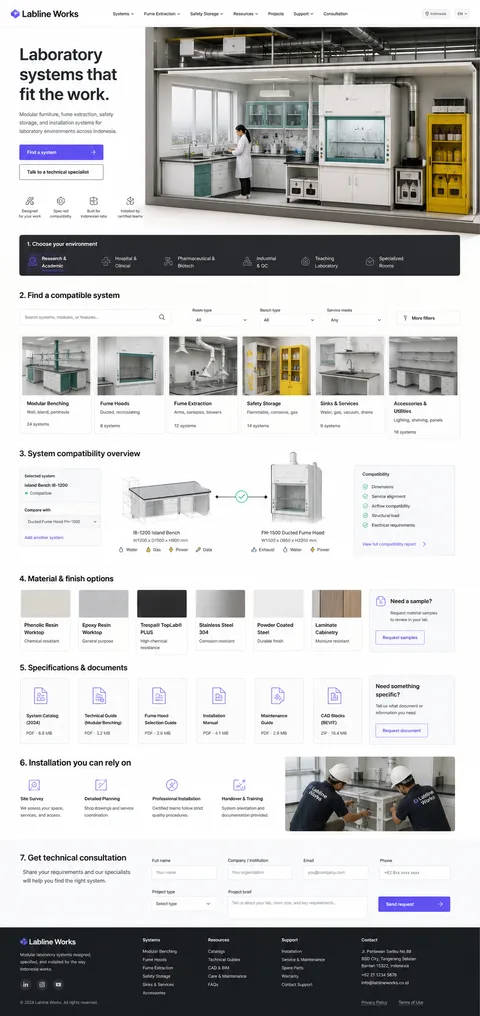
Picture the result
Products that are easy to browse and ask about
An illustrative catalog with categories, product details, and inquiry actions aligned with your existing sales process.
Typical structure
The parts usually worth including.
- 01Catalog home
- 02Category listing
- 03Product or service listing
- 04Product or service detail
- 05Search or filters when useful
- 06Ordering guidance and contact
Scope
Foundations that can be included in the work.
Common inclusions
- Category, attribute, and detail-structure planning
- Responsive listing and detail views
- Inquiry paths through WhatsApp, email, or another agreed channel
- Image optimization, metadata, and baseline URL structure
- A catalog management model appropriate to the selected solution
- Initial example data setup in the amount written into the proposal
Additional options
- Search, filters, tags, variants, documents, or galleries
- Data synchronization from spreadsheets, APIs, ERP, or another source after feasibility review
- Quote requests, selection lists, or product sharing
- Additional email, storage, traffic, or specialized data-sync capacity
Plan pricing applies to the standard scope. Custom integrations, added functionality, and requirements beyond fair use are itemized separately in the proposal.
Recommended plan
Kilat Lengkap
A non-transactional website built and managed under one annual price.
For a catalog that directs orders to WhatsApp or email. Choose Kilat Niaga when stock, checkout, or an order dashboard is required.
What to prepare
Materials from your side of the business.
- 01Product or service list and an initial category structure
- 02Names, descriptions, photos, specifications, documents, and price-display policy
- 03Inquiry workflow, service region, and the team receiving questions
- 04Expected update frequency and ownership of catalog maintenance
Service flow
Decisions happen before implementation expands.
- 01
Audit the data
We review item types, attributes, categories, volume, photo quality, and the intended update workflow.
- 02
Design discovery
Listings, detail pages, search, filters, and inquiry paths follow the way customers choose.
- 03
Build and seed
Catalog components are built and tested with representative data agreed in the scope.
- 04
Test management
The team reviews the visitor experience and update workflow before launch.
Service questions
Details that need agreement.
01How is an online catalog different from an online store?
A catalog supports browsing and inquiry through your sales process. A store usually adds cart, checkout, payment, order status, and other transaction requirements.
02Must prices be public?
No. Prices can be shown, hidden, expressed as ranges, or replaced by a quote request according to policy and available data.
03How many products can it contain?
Technical capacity and initial setup are separate questions. Data volume, import method, material quality, and update responsibility are written into the proposal.
04Can visitors search and filter?
Yes when attributes are consistent and the controls help. Filters should follow real customer decisions rather than exist for decoration.
05Can it become an online store later?
Often yes, but transactions, platform, data, integrations, security, and migration need a new assessment first.
Start a conversation
Let’s discuss your website.
Bring the goal, the material you have, and anything that still feels unclear. We can start there.