
Online Store Website Design
An online store with catalog, cart, checkout, order management, and transaction integrations planned around the way your business operates.
Add to the Quick BriefAn online store reaches far beyond product presentation. Inventory changes, failed payments, delivery costs, cancellations, notifications, and team access all shape the customer experience.
Online Store is included in Kilat Niaga at the introductory price of IDR 8.9 million per year, with a 5-10-working-day launch target after product data, transaction rules, provider accounts, and every launch input have been confirmed complete. Integrations and operations outside the standard scope are agreed separately.
Good fit for
A good fit when customers need to choose products and complete transactions on the website while your team needs clear order, payment, shipping, and service workflows.
What needs to improve
- Customers can browse, choose, and begin transactions through a consistent flow
- The team gains a more structured source of orders and statuses
- Product, payment, shipping, and notification rules are discussed before implementation
- Operational and platform-maintenance responsibilities become clearer
Picture the result
From product choice to recorded order
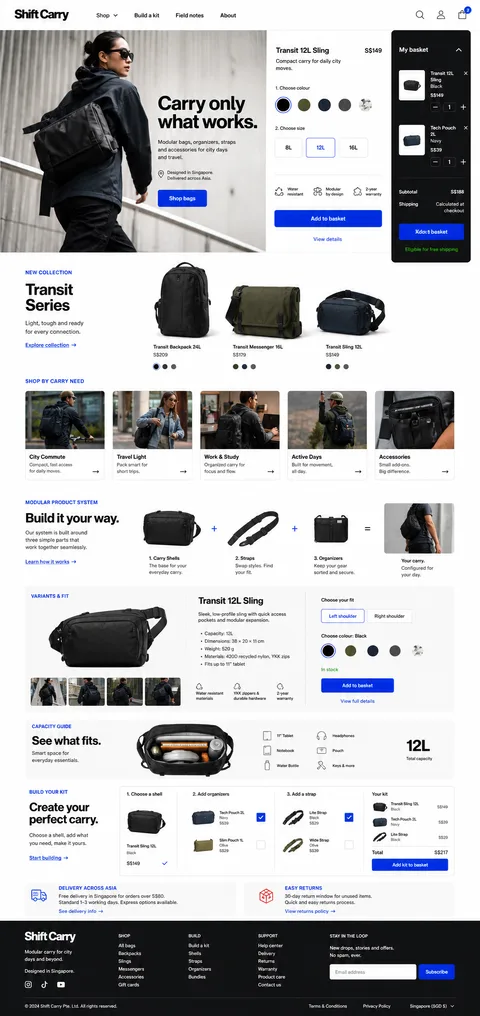
An illustrative store flow combining catalog, cart, checkout, and order status with the operating process behind it.
Typical structure
The parts usually worth including.
- 01Store home
- 02Product categories and search
- 03Product detail and variants
- 04Cart and checkout
- 05Confirmation and order status
- 06Customer account when needed
- 07Transaction policies, privacy, and contact
Scope
Foundations that can be included in the work.
Common inclusions
- Catalog, variant, inventory, price, tax, and transaction-rule mapping
- Responsive storefront and platform-appropriate checkout flow
- Product and order management for the selected solution
- Setup of agreed payment and shipping integrations
- Metadata, social preview, baseline analytics, and asset optimization
- Manual entry for up to 1,000 initial products, or a complete catalog import when the data is ready
Additional options
- Coupons, promotions, customer accounts, reviews, wishlists, or notifications
- Payments, delivery rates, couriers, invoices, tax, or operational integrations
- Data import, inventory sync, marketplaces, ERP, or APIs after feasibility review
- Additional transactional email, storage, traffic, or specialized operating capacity
Plan pricing applies to the standard scope. Custom integrations, added functionality, and requirements beyond fair use are itemized separately in the proposal.
Recommended plan
Kilat Niaga
An online store with sales operations tooling and annual website management.
For a self-managed catalog, stock, cart, payments, shipping, and order management.
What to prepare
Materials from your side of the business.
- 01Product, variant, price, stock, weight, photo, and category data
- 02Payment, shipping, return, cancellation, tax, and customer-service policies
- 03Business accounts for the payment or delivery providers being considered
- 04An operational owner who can test orders and approve the workflow
Service flow
Decisions happen before implementation expands.
- 01
Map transactions
We map products, pricing rules, stock, payment, shipping, notifications, and exception handling.
- 02
Choose architecture
Platform, data, integrations, access, security, and operational responsibilities follow the requirements.
- 03
Build and test
The catalog and checkout are built, then tested against relevant order and failure scenarios.
- 04
Prepare operations
The team reviews product, order, refund, support, backup, and launch responsibilities in the proposal.
Service questions
Details that need agreement.
01Can online payment be included?
An integration can be included when the provider, business account, third-party cost, region, methods, and requirements are agreed. WebsiteKilat cannot guarantee provider approval.
02Can shipping rates be calculated automatically?
This may be possible through the chosen platform or service. Couriers, origin, weight, dimensions, API limits, and service costs need review.
03How many products will be entered?
Kilat Niaga includes manual entry for up to 1,000 initial products, or a complete catalog import when the spreadsheet and images follow the agreed format. After launch, your team can add and update products directly.
04Is an online store free of recurring costs?
A standard domain, hosting, SSL, business email, security, backups, and annual maintenance are included. Transaction fees, specialized transactional email, shipping services, third-party licenses, and non-standard integrations may be charged separately.
05Who handles orders and customers?
Your business team remains responsible unless another service is agreed. The website supports the flow but does not replace stock, shipping, refund, and customer-service decisions.
Start a conversation
Let’s discuss your website.
Bring the goal, the material you have, and anything that still feels unclear. We can start there.