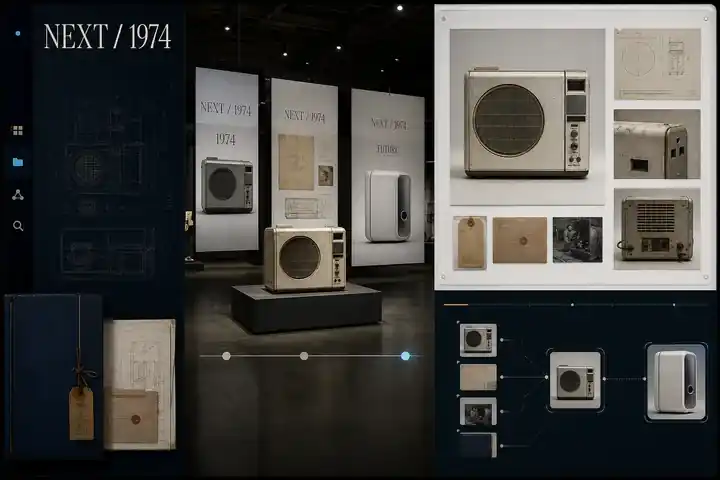
01 / Overview
Feels cultural, scholarly, future facing, with a deliberate rather than generic personality.
Signature move
Archival identifiers become links that visibly connect past artifacts to present projects or decisions.
- Intensity
- restrained
- Versatility
- 4 / 5
- ID
archive-future
02 / Example art
Archive Future
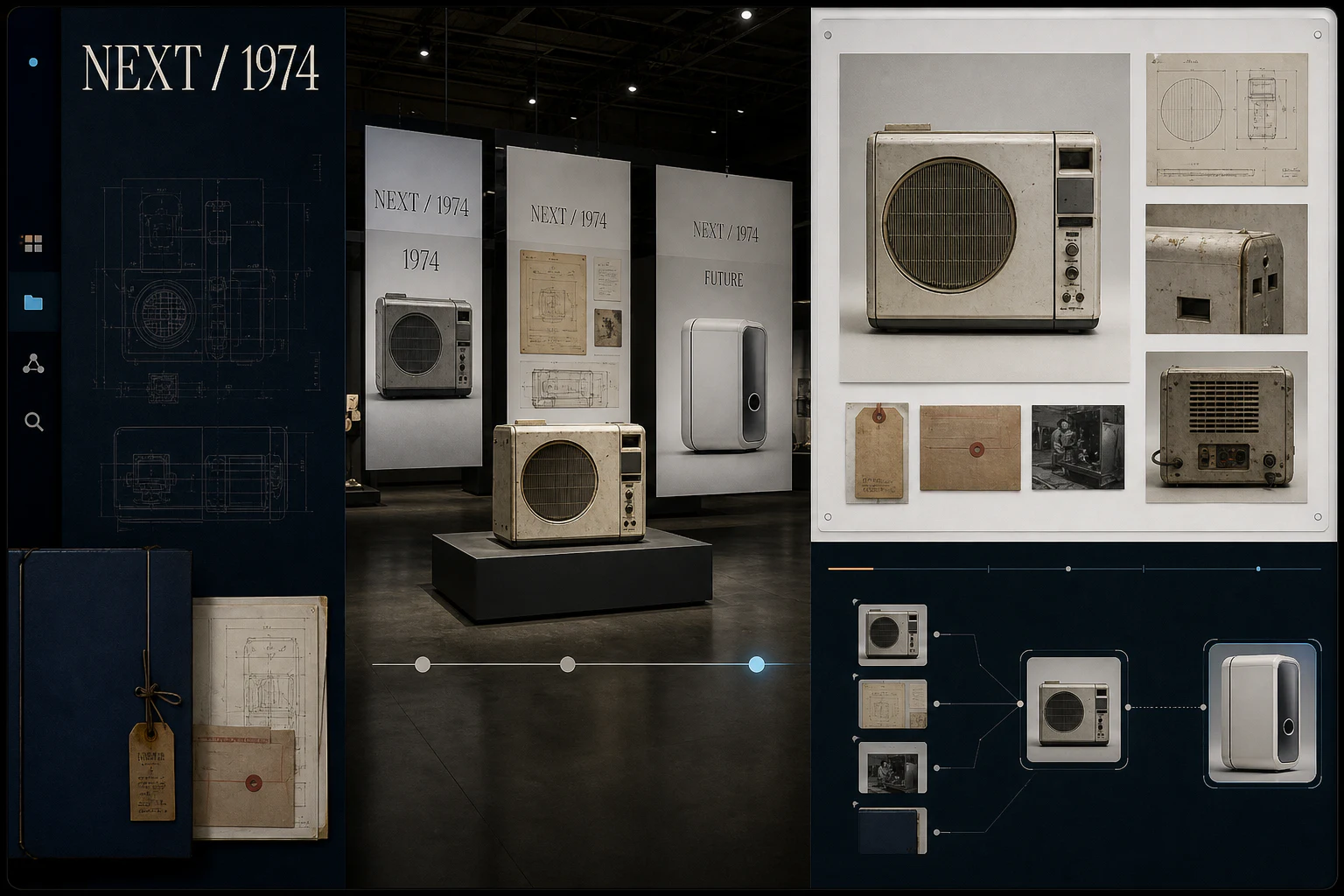
Original artwork establishes the direction's visual language before it is translated into an interface.
03 / Website example
Try the page as a working experience
Explore this responsive page directly inside the catalog. Its primary navigation, controls, and interactions are live; open it full screen to experience the original composition.
Examples are in production
The direction is available now. Its brand websites are being built as independent sites and will appear here during local production.
04 / Fit
Suitable for
Suitable for
heritage / museum / education / fashion / architecture / media
Business goals
archive / discover / connect / reinterpret
A strong choice when
Strong when heritage, museum, education, fashion need to archive, discover, connect through a memorable but repeatable visual system.
Avoid when
Avoid when the brief needs complete visual neutrality or when this direction would compete with essential information and actions.
05 / Design system
Design system
Rules that should remain coherent as content, devices, and business needs change.
- 01Composition
- Dense index views open into spacious artifact records and visible relationship maps.
- 02Hierarchy
- Make the signature move the first organizing decision, then reveal supporting information through stable scale, alignment, and sequence.
- 03Typography
- Bookish serif or archival display face paired with precise searchable metadata.
- 04Color
- Deep ink, paper, oxide, or collection-specific colors paired with a clear contemporary signal.
- 05Imagery
- High-resolution artifacts, edges, backs, stamps, and context documents shown without fake restoration.
- 06Material
- Folders, bindings, plates, stamps, and catalog numbers become navigation logic rather than texture.
- 07Motion
- Connections draw between records; time and provenance remain inspectable and reversible.
Adaptation
Keep the signature move invariant. Adapt imagery, material, language, and interaction to the actual heritage, museum, education context rather than copying a finished reference.
Accessibility
Use progressive disclosure, stable alignment, and generous line spacing for dense information. Meet WCAG AA contrast, visible focus, 44px targets, and never encode meaning through color or style alone.
06 / Background
Background
These lineages are source-linked research doors, not permission to copy a particular work or brand.
- 01ex libris
- 02celestial atlas
- 03private press
- 04infinite canvas
Guardrail
Expose provenance gaps, rights, and contested histories rather than presenting the archive as complete.
07 / Agent recipe
archive-future
Use the stable ID and recipe to give design agents the same context. Always adapt the output to the real business.
Prompt recipe
Use case: stylized-concept
Asset type: Aesthetic Directions Encyclopedia showcase, 3:2 landscape master
Primary request: Create one polished freeform showcase for Archive Future, applied to NEXT / 1974, a clearly fictional industrial innovation archive.
Scene/backdrop: an exhibition pairing a 1970s prototype, its archival documents, and a speculative future object along one inspectable timeline.
Style/medium: A coherent contemporary design world, not a collage of references. Make deep history feel active, searchable, and capable of generating new work.
Composition/framing: Dense index views open into spacious artifact records and visible relationship maps. Keep all important content inside an 8 percent safe margin.
Typography: Bookish serif or archival display face paired with precise searchable metadata.
Color palette: Deep ink, paper, oxide, or collection-specific colors paired with a clear contemporary signal.
Imagery: High-resolution artifacts, edges, backs, stamps, and context documents shown without fake restoration.
Materials/textures: Folders, bindings, plates, stamps, and catalog numbers become navigation logic rather than texture.
Text (verbatim): "NEXT / 1974". No other readable words.
Constraints: Original fictional concept; visibly applied to exhibition, editorial, website; realistic production detail; no real company, client, result, claim, signature, or watermark; no imitation of a living artist or proprietary campaign.
Avoid: sepia nostalgia, archive-as-mood without metadata, futuristic effects that overpower artifacts, real logos, watermarks, artist imitation, generic mood board, illegible filler text.
Pilot refinement: Make one dominant integrated real-world application readable at thumbnail scale. Secondary views may support it but must remain subordinate. Do not create an equal-weight tiled mood board or generic presentation collage unless sequencing is essential to the direction. Render the exact requested text correctly and do not invent other readable copy.
Working constraints
- Use one coherent direction grammar, not a collage of style references.
- Use only a fictional business and minimal exact text.
- Do not imitate a living artist, real brand, client project, or proprietary campaign.
- Preserve essential hierarchy, legibility, contrast, and reduced-motion equivalence.
- Avoid: sepia nostalgia.
- Avoid: archive-as-mood without metadata.
- Avoid: futuristic effects that overpower artifacts.
08 / Sources & rights
Sources & rights
Work ownerSol
Example licenseAll rights reserved
- 01
The Bookplate Society
Role: lineage · Linked source retains its own rights; IndexStyle structured description is CC BY 4.0.
- 02
Linda Hall Library
Role: lineage · Linked source retains its own rights; IndexStyle structured description is CC BY 4.0.
- 03
V&A — William Morris コレクション
Role: lineage · Linked source retains its own rights; IndexStyle structured description is CC BY 4.0.
- 04
Scott McCloud — The "Infinite Canvas" (一次資料・命名者本人のサイト)
Role: lineage · Linked source retains its own rights; IndexStyle structured description is CC BY 4.0.
The choice will be carried into the Quick Brief and can still be removed before sending.
Choose this style